
Agricultural Machinery · Biomass Pellet Machine
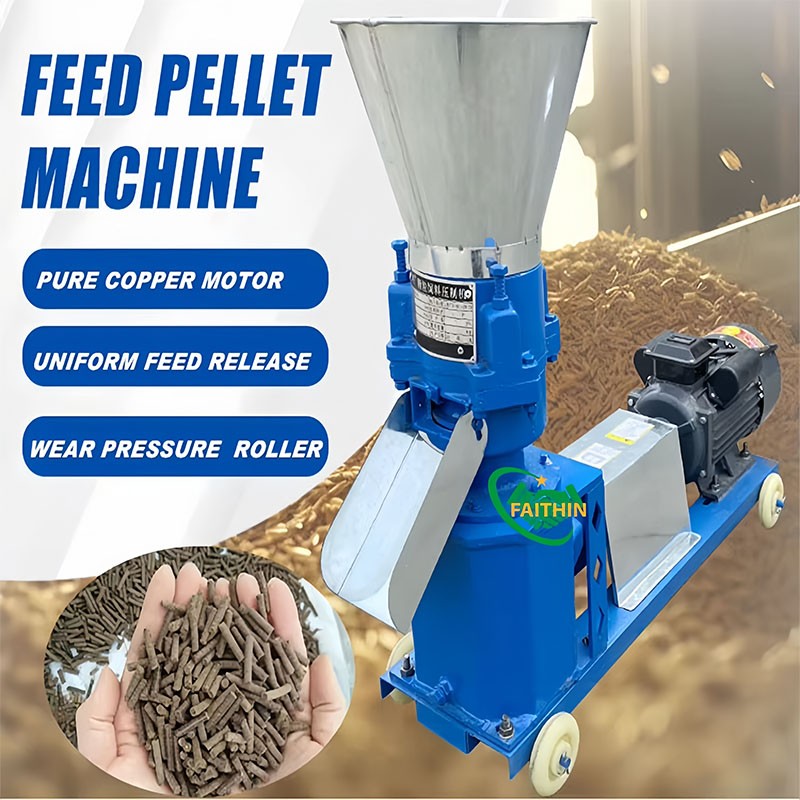
Biomass Pellet Machine Flat Die
<strong>Model:</strong> Biomass Pellet Machine Flat Die
Product Overview
Biomass pellet machines convert agricultural waste (sawdust, rice husk, wheat straw, peanut shells) into dense pellets suitable for home heating, industrial boilers, power generation and animal bedding. Pellets have 2–3× higher energy density than loose biomass.
Two Main Designs
• Flat Die — lower cost, compact, 40–500 kg/h capacity, ideal for small farms and workshops. Dies and rollers are relatively easy to replace. • Ring Die — higher capacity (500–2000 kg/h), more durable die, industrial-grade construction for continuous 24/7 operation.
Working Principle
Raw material is conditioned (moisture 12–15%) then fed into the chamber between die and rollers. Rollers press the material through die holes. Heat from friction lignifies the biomass, binding particles. Pellets emerge 6–12 mm diameter, hard and dense. A short cooling step hardens them fully.
Raw Material Prep
Sawdust and rice husk need no pre-grinding. Straw and peanut shells need hammer mill grinding first. All materials must have 12–15% moisture — too dry will break die, too wet won't pellet. Use a dryer if needed.
Complete Line
Full biomass pellet production line: Hammer mill → Dryer (if needed) → Pellet machine → Cooler → Packing scale. We can supply the complete matched line for any capacity from 200 kg/h to 2000 kg/h.
FAQ
Q1.What raw materials can it pelletize?
Sawdust, wood chips, rice husk, straw, peanut shell, banana stem residue and most dry biomass. Material must be under 10 mm and at 12-15% moisture.
Q2.What pellet sizes can it make?
Standard dies produce 6 mm, 8 mm and 10 mm pellets. 8 mm is the most popular all-round size for household stoves and small boilers.
Q3.How long does the die last?
With clean wood dust, a die typically lasts several hundred tonnes. Keep spare dies and rollers in stock to avoid downtime.
Q4.Do I need a dryer before pelletizing?
Only if your material arrives wet. Fresh material at 40-60% moisture must be dried to 12-15% first, by sun drying or a drum dryer.
Can't find what you need?
Tell us your capacity and raw material requirements — we will recommend the right machine and quote within 24 hours.
Send Inquiry